
Last Updated: July 2026 | Reviewed by: SmartEmailAI Editorial Team | Reading Time: 16 minutes
In This Guide
In this guide, you’ll learn:
- What AI email personalization is and why it matters.
- How AI personalizes email campaigns using customer data.
- The biggest benefits for marketers and businesses.
- Real-world examples of AI-powered personalized emails.
- Common mistakes to avoid.
- Best practices for improving engagement and conversions.
- The leading AI tools that support email personalization.
Table of Contents
AI email personalization uses artificial intelligence to create more relevant emails for each recipient. It personalizes content, subject lines, product recommendations, and send times based on customer behavior, preferences, and engagement history. Unlike traditional personalization, which mainly adds basic details like a recipient’s name, AI analyzes customer data to deliver messages that improve engagement and conversions. Businesses use AI email personalization to automate repetitive tasks, build stronger customer relationships, and improve email performance. Whether you’re running an ecommerce store, a SaaS company, or a B2B business, AI helps you send the right message to the right person at the right time
Introduction
Every day, people receive dozens of marketing emails competing for their attention. Yet most of them are ignored because they feel generic, irrelevant, or poorly timed.
Today’s customers expect more than seeing their first name in the subject line. They expect emails that reflect their interests, recommend relevant products, and arrive when they’re most likely to engage. Meeting those expectations manually is nearly impossible, especially as subscriber lists continue to grow.
This is where AI email personalization makes a difference.
By analyzing customer behavior, preferences, purchase history, and engagement patterns, artificial intelligence helps businesses deliver emails that feel more relevant to each recipient. Instead of sending one message to everyone, marketers can automatically tailor content, recommendations, and timing to create a more personalized experience.
The benefits extend beyond better customer experiences. AI-powered personalization can increase open rates, improve click-through rates, strengthen customer relationships, and save valuable time by automating many repetitive marketing tasks.
In this guide, you’ll learn what AI email personalization is, how it works, its key benefits, real-world applications, and the best practices for using it effectively. You’ll also discover the AI-powered tools that make personalized email marketing easier for businesses of all sizes.
What Is AI Email Personalization?
AI email personalization is the process of using artificial intelligence to automatically tailor email content for individual recipients based on their behavior, preferences, demographics, purchase history, and interactions with a business.
Unlike traditional email personalization-which often stops at inserting a subscriber’s first name–AI analyzes large amounts of customer data to determine what each person is most likely to find relevant. This enables marketers to send emails that feel individually crafted without manually creating separate campaigns for every subscriber.
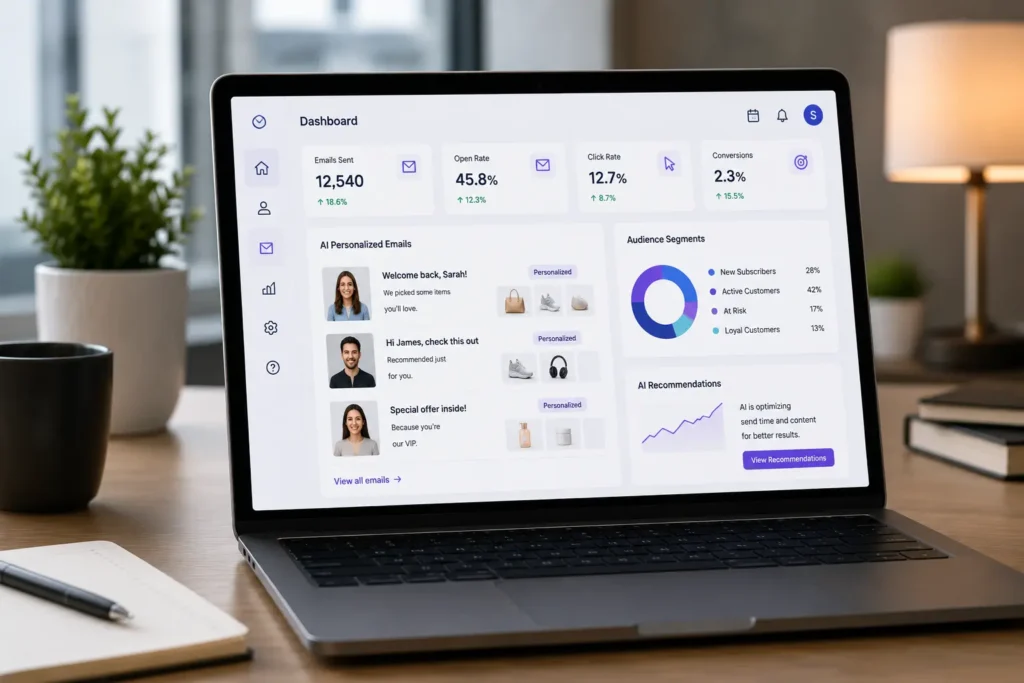
For example, instead of sending the same promotional email to an entire mailing list, an AI-powered system can automatically:
- Recommend products based on previous purchases.
- Display different content blocks for different audience segments.
- Personalize subject lines according to user behavior.
- Send emails at the time each recipient is most likely to open them.
- Adjust offers based on customer engagement or lifecycle stage.
The result is a far more relevant experience for every subscriber while significantly reducing the manual work required to manage personalized campaigns.
This level of personalization has become increasingly important as inboxes grow more crowded. Consumers now expect brands to understand their interests and communicate in ways that feel timely and helpful rather than generic.
Many businesses combine AI personalization with reusable templates to streamline campaign creation. If you’re interested in creating high-quality templates before personalizing them, our guide to Best AI Email Template Generators in 2026 explains how AI can dramatically speed up the writing process while maintaining consistency across campaigns.
Why AI Email Personalization Matters
Modern consumers expect more than generic marketing emails. They want content that reflects their interests, arrives at the right time, and provides real value. As inboxes become increasingly crowded, businesses that continue sending the same message to every subscriber often struggle to capture attention and drive engagement.
AI email personalization helps solve this challenge by using customer data and behavioral insights to deliver more relevant experiences at scale. Instead of relying on broad audience segments or manual personalization, AI can automatically tailor content, recommendations, and send times for individual recipients.
This shift is changing the way businesses approach email marketing. Rather than focusing on sending more emails, marketers are focusing on sending smarter emails—messages that are more likely to be opened, read, and acted upon.
For companies looking to build stronger customer relationships while improving marketing efficiency, AI-powered personalization has become an essential capability rather than a competitive advantage.
How AI Email Personalization Works
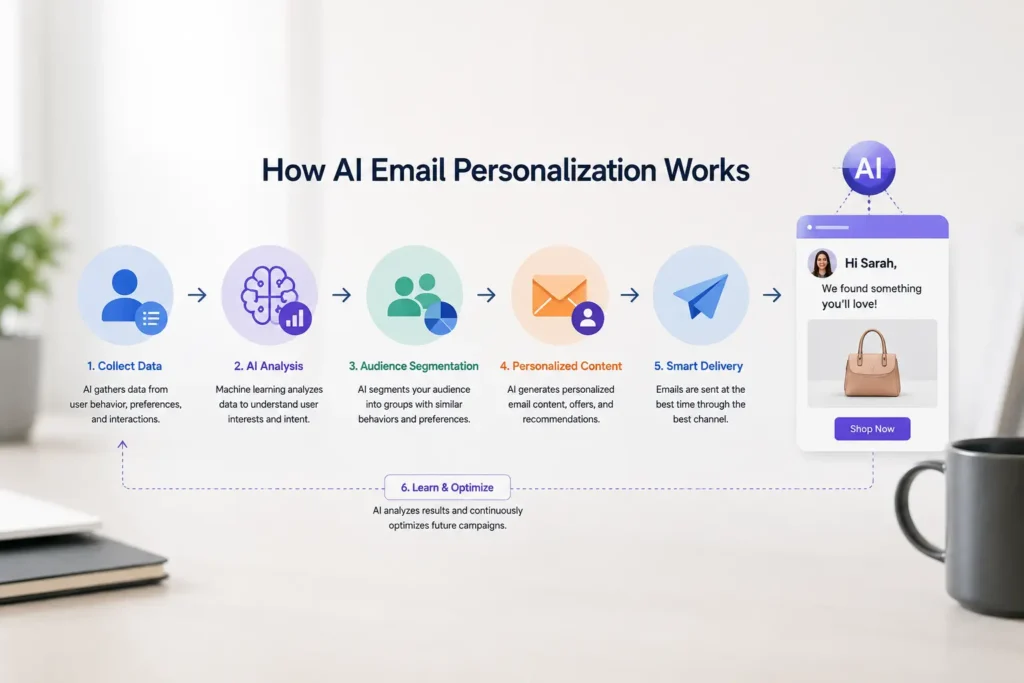
AI email personalization follows a simple process: it collects customer data, identifies patterns, and uses those insights to deliver more relevant emails automatically. Instead of relying on broad audience segments, AI continuously adapts campaigns based on individual behavior.
Here’s how it works:
1. Collecting Customer Data
AI gathers data from multiple sources, including email engagement, website activity, purchase history, CRM records, and customer preferences. This information provides the foundation for personalized email experiences.
2. Analyzing Customer Behavior
Machine learning identifies patterns in how subscribers interact with emails and websites. It can recognize interests, predict future actions, and determine which content is most relevant for each individual.
3. Creating Personalized Content
Using these insights, AI generates or selects personalized subject lines, product recommendations, offers, and email content. Instead of sending one generic message, each subscriber receives content tailored to their needs and interests.
4. Optimizing Delivery
AI also determines the best time to send each email based on previous engagement patterns. Many platforms automatically optimize delivery to improve open rates and increase the likelihood of interaction.
5. Learning from Results
After every campaign, AI analyzes performance metrics such as opens, clicks, conversions, and unsubscribes. These insights help improve future campaigns, making personalization more accurate over time.
Rather than replacing marketers, AI automates repetitive tasks while giving businesses the insights needed to create more relevant and engaging email campaigns at scale.
Types of AI Email Personalization
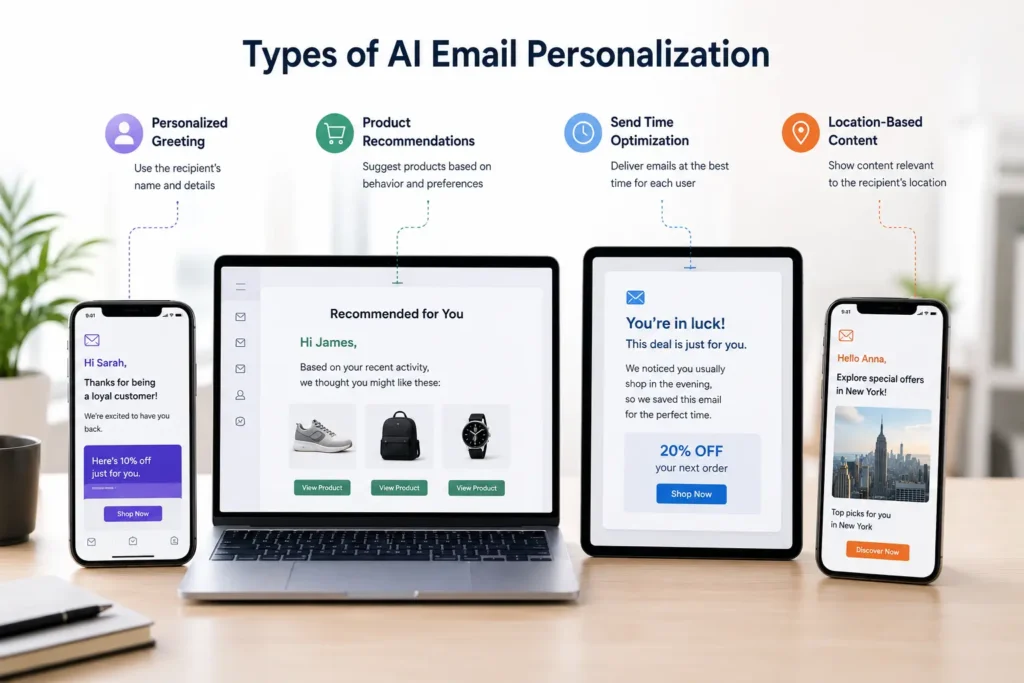
AI email personalization goes far beyond adding a recipient’s first name to an email. Modern AI can personalize multiple elements of a campaign to make every message more relevant and engaging.
Here are the most common types of AI email personalization used today.
Personalized Subject Lines
AI analyzes engagement data to generate subject lines that are more likely to capture each subscriber’s attention. Some platforms can even create multiple variations and optimize them for different audience segments.
Dynamic Email Content
Instead of sending identical emails to everyone, AI adjusts the content based on each subscriber’s interests, behavior, or stage in the customer journey. This may include personalized recommendations, educational resources, or promotional offers.
Product Recommendations
AI uses browsing history, purchase behavior, and customer preferences to recommend products that are most relevant to each recipient. This type of personalization is widely used in ecommerce to increase conversions and repeat purchases.
Behavioral Trigger Emails
Rather than following a fixed schedule, AI can automatically send emails when specific actions occur, such as creating an account, abandoning a cart, completing a purchase, or becoming inactive.
Send-Time Optimization
Not every subscriber checks their inbox at the same time. AI analyzes past engagement to predict when each person is most likely to open an email, helping businesses improve visibility and engagement without changing the message itself.
As AI technology continues to evolve, many email marketing platforms combine several of these personalization techniques into a single campaign, allowing businesses to deliver highly relevant customer experiences with minimal manual effort.
Benefits of AI Email Personalization
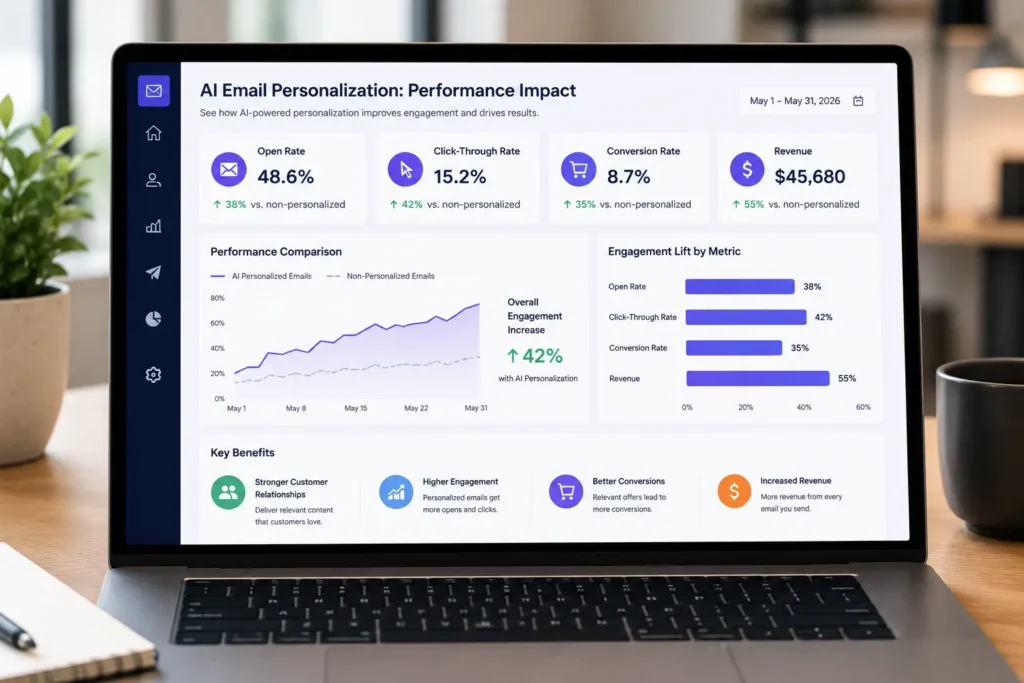
AI email personalization helps businesses deliver more relevant customer experiences while improving the performance of their email campaigns. By using customer data and behavioral insights, marketers can move beyond generic messaging and create emails that are more likely to engage each recipient.
Here are the biggest benefits of adopting AI-powered personalization.
Higher Engagement and Conversions
Personalized emails are more likely to be opened, clicked, and acted upon than generic campaigns. By delivering relevant content, product recommendations, and tailored offers, AI helps businesses increase engagement throughout the customer journey and improve conversion rates.
Stronger Customer Relationships
Customers are more likely to engage with brands that consistently send useful and relevant emails. AI helps businesses build trust by adapting content to individual interests and behaviors, creating a more personalized experience over time.
Improved Marketing Efficiency
Creating personalized campaigns manually can be time-consuming, especially for large subscriber lists. AI automates tasks such as audience segmentation, content recommendations, send-time optimization, and campaign analysis, allowing marketing teams to focus on strategy instead of repetitive work.
Smarter Decision-Making
AI continuously analyzes campaign performance, providing insights into customer behavior, engagement trends, and content preferences. These insights help marketers optimize future campaigns and make data-driven decisions with greater confidence.
When combined with a well-planned email marketing strategy, AI personalization enables businesses to deliver more relevant communication while saving time and improving overall campaign performance.
Real-World Examples of AI Email Personalization
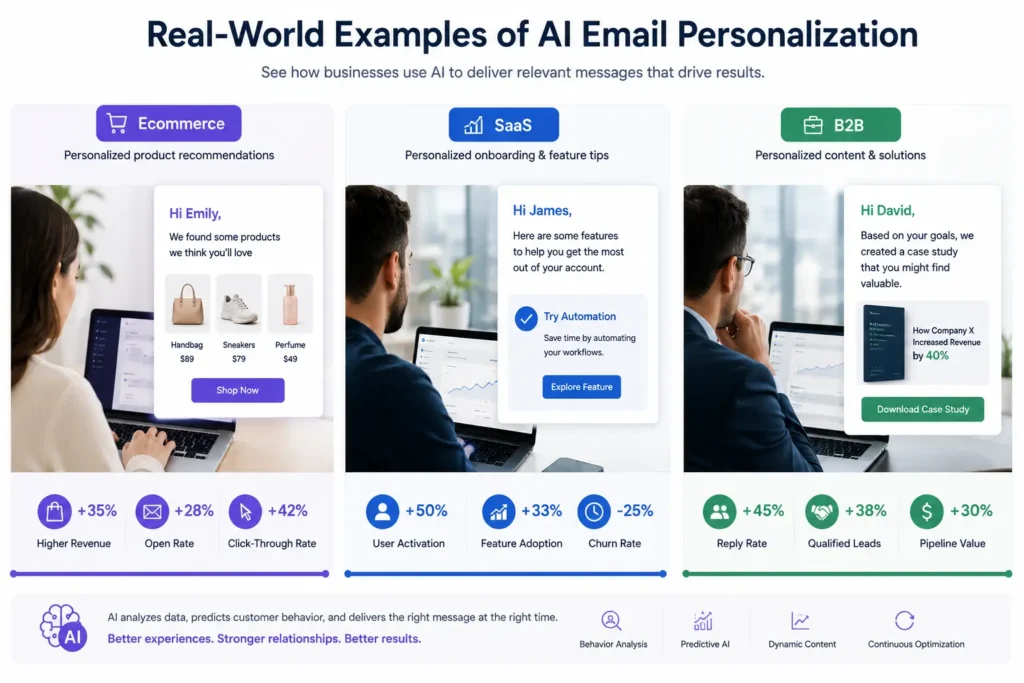
AI email personalization is used across many industries to deliver more relevant customer experiences. Here are a few practical examples.
Ecommerce: Personalized Product Recommendations
When a customer views products without making a purchase, AI can automatically send a follow-up email featuring recently viewed items, similar products, or limited-time offers. This helps businesses recover abandoned shopping journeys and increase conversions.
SaaS: Smarter User Onboarding
Software companies use AI to personalize onboarding emails based on user activity. New users may receive setup guides, while active users get advanced tips or feature recommendations. This creates a smoother onboarding experience and encourages product adoption.
B2B Lead Nurturing
In B2B marketing, AI personalizes emails according to where prospects are in the buying journey. Educational content can be sent to new leads, while pricing information, case studies, or product demos are delivered to prospects showing stronger purchase intent.
Re-Engaging Inactive Subscribers
AI can identify subscribers who have stopped interacting with emails and automatically launch re-engagement campaigns. These messages may include personalized recommendations, exclusive offers, or requests to update communication preferences, helping businesses reconnect with inactive audiences.
These examples show that AI email personalization is more than adding a customer’s name to an email. It helps businesses deliver relevant content at the right time, creating better customer experiences while improving campaign performance
Popular AI Tools That Support Email Personalization
Many modern email marketing platforms now include AI-powered personalization features. While their capabilities vary, these tools help businesses deliver more relevant emails by using customer data, behavioral insights, and automation.
Here are some of the most popular options:
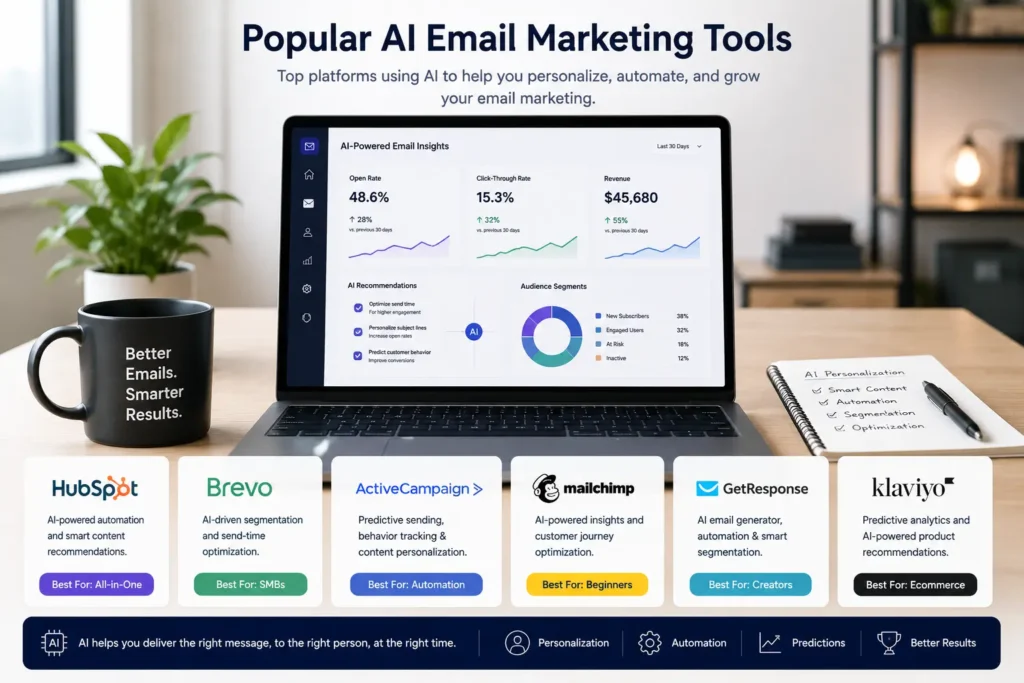
| Tool | Best For |
| HubSpot | CRM-powered personalization and marketing automation |
| ActiveCampaign | Advanced automation and behavioral targeting |
| Brevo | Small businesses and affordable AI email marketing |
| GetResponse | AI-powered campaigns and lead nurturing |
| Mailchimp | Beginner-friendly email personalization |
Each platform approaches personalization differently. Some focus on CRM-driven customer journeys, while others specialize in behavioral automation or AI-assisted content generation.
If you’re looking for a detailed comparison of these platforms, explore our guides to Best AI Email Marketing Tools in 2026, Best AI Email Assistants in 2026, and Best AI Email Template Generators in 2026.
Common Mistakes to Avoid
AI can significantly improve email personalization, but technology alone doesn’t guarantee better results. Many businesses reduce the effectiveness of their campaigns by making avoidable mistakes.
Here are some of the most common ones.
Relying on Poor-Quality Data
AI is only as effective as the data it receives. Outdated contact information, incomplete customer profiles, or inaccurate purchase history can lead to irrelevant recommendations and poorly targeted emails.
Regularly cleaning and updating your customer data is essential for successful personalization.
Over-Personalizing Every Email
Adding too much personal information can make emails feel intrusive rather than helpful.
Instead of trying to personalize every sentence, focus on the elements that genuinely improve relevance, such as product recommendations, content preferences, or behavioral triggers.
Ignoring Customer Segmentation
Sending highly personalized content to poorly segmented audiences often produces disappointing results.
Before launching AI-powered campaigns, ensure subscribers are grouped according to meaningful factors such as interests, engagement level, purchase history, or lifecycle stage.
Forgetting to Test Campaigns
Even the smartest AI models benefit from continuous optimization.
Monitor key metrics such as:
- Open rate
- Click-through rate
- Conversion rate
- Unsubscribe rate
Regular testing helps identify what works best for your audience and allows AI systems to improve future recommendations.
Prioritizing Automation Over Value
Automation should enhance the customer experience-not replace it.
Every personalized email should answer a simple question:
“Does this message provide something genuinely useful for the recipient?”
If the answer is no, no amount of AI will make the campaign successful.
Best Practices for AI Email Personalization
To get the most value from AI email personalization, follow these best practices:
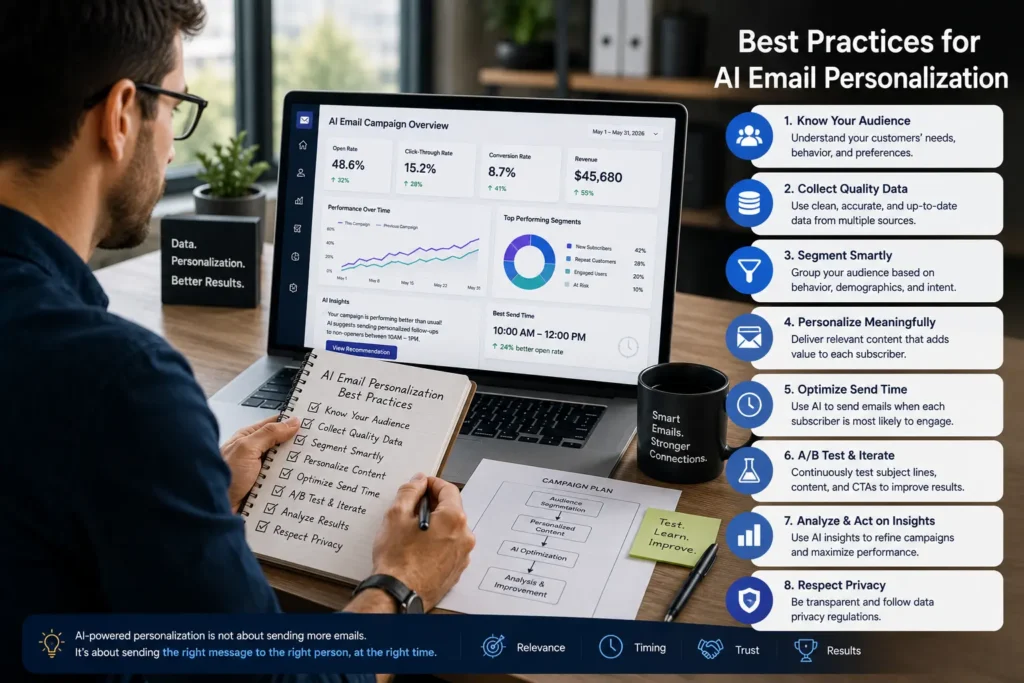
✅ Keep your customer data up to date.
AI performs best when it has accurate and complete customer information.
✅ Segment your audience before personalizing.
Group subscribers by behavior, interests, or lifecycle stage to deliver more relevant content.
✅ Personalize more than just the first name.
Use AI to tailor recommendations, offers, content, and send times-not just greetings.
✅ Review AI-generated content before sending.
AI can save time, but a quick human review helps maintain accuracy and your brand voice.
✅ Test different personalization strategies.
Use A/B testing to compare subject lines, content variations, and calls to action.
✅ Respect customer privacy.
Be transparent about how you collect and use customer data, and follow applicable privacy regulations.
✅ Monitor campaign performance regularly.
Track open rates, click-through rates, conversions, and unsubscribes to continuously improve future campaigns.
Pro Tip: AI works best when combined with a clear email marketing strategy. Automation can improve efficiency, but understanding your audience remains the foundation of successful personalization.
AI works best when combined with a clear email marketing strategy. Automation can improve efficiency, but understanding your audience remains the foundation of successful personalization.
Frequently Asked Questions
What is AI email personalization?
AI email personalization uses artificial intelligence to tailor email content, recommendations, subject lines, and send times based on customer data, behavior, and preferences. Its goal is to deliver more relevant emails that improve engagement and conversions.
How is AI personalization different from traditional email personalization?
Traditional personalization usually inserts basic information such as a recipient’s name or company. AI personalization goes much further by analyzing customer behavior, predicting interests, dynamically adjusting content, and optimizing the entire email experience.
Can small businesses use AI email personalization?
Yes. Many modern email marketing platforms—including Brevo, Mailchimp, HubSpot, and GetResponse—offer AI-powered personalization features that are suitable for small businesses as well as larger organizations.
Does AI email personalization improve open rates?
In many cases, yes. By generating more relevant subject lines, optimizing send times, and delivering personalized content, AI can help increase open rates and improve overall campaign performance.
Which tools offer AI email personalization?
Many modern email marketing platforms support AI personalization, including HubSpot, ActiveCampaign, Brevo, GetResponse, and Mailchimp. If you’re comparing platforms, check out our Best AI Email Marketing Tools in 2026 guide for a detailed comparison..
Is AI email personalization worth it?
For most businesses, yes. AI reduces manual work while helping marketers deliver more relevant customer experiences. When implemented correctly, it can improve engagement, increase conversions, and strengthen long-term customer relationships.
Conclusion
AI email personalization has become an essential part of modern email marketing. By using customer data, behavioral insights, and automation, businesses can deliver more relevant emails that improve engagement, strengthen customer relationships, and save valuable time.
The key to success isn’t simply using AI—it’s using it strategically. Start with clean customer data, focus on delivering genuine value, and continuously optimize your campaigns based on performance. Even small improvements in personalization can have a meaningful impact on your email marketing results over time.
If you’re ready to put AI personalization into practice, the next step is choosing the right tools. Explore our Best AI Email Marketing Tools in 2026 guide to compare the leading platforms, or read Best AI Email Assistants in 2026 and Best AI Email Template Generators in 2026 to discover solutions that can help you create smarter, more effective email campaigns.
As AI technology continues to evolve, businesses that embrace personalized communication today will be better positioned to build stronger customer relationships and achieve long-term growth.