
Confused about CRM vs email marketing? Discover the 7 key differences, AI-powered features, pricing, and the best tools for ecommerce, SaaS, creators, and affiliate marketers in 2026.
Table of Contents
CRM vs Email Marketing: What’s the Difference and Which One Do You Need?
Many business owners invest in the wrong software because they misunderstand the difference between CRM and email marketing.
Some purchase a CRM before they even have a sales process. Others rely solely on email marketing when they actually need a system to manage leads and customer relationships.
The result?
Lost sales, fragmented customer data, and unnecessary software expenses.
In 2026, the confusion is even greater because modern platforms combine features from both categories. Many email marketing tools now include CRM-like capabilities, while CRMs increasingly offer email automation and AI-powered marketing features.
So what exactly is the difference?
A CRM helps you manage customer relationships and sales opportunities. Email marketing helps you communicate with audiences at scale through campaigns, automation, and personalization.
The challenge is understanding which one your business actually needs.
In this guide, you’ll learn:
- What CRM software does
- What email marketing software does
- The 7 biggest differences between them
- How AI is changing both categories
- Which tools are best for different business models
- Whether you need CRM, email marketing, or both
By the end, you’ll know exactly which solution fits your business and growth goals.
Quick Answer: CRM vs Email Marketing
If you’re looking for the short version:
| Feature | CRM | Email Marketing |
| Main Purpose | Manage customer relationships | Communicate with audiences |
| Best For | Sales teams and B2B businesses | Ecommerce, creators, affiliates |
| Lead Management | Advanced | Basic |
| Sales Pipeline | Yes | No |
| Email Campaigns | Limited | Core feature |
| Automation | Sales workflows | Marketing workflows |
| AI Features | Lead scoring, forecasting | Personalization, content generation |
| Revenue Tracking | Sales revenue | Campaign revenue |
The Simple Rule
- Choose CRM if your business depends on sales conversations and deal management.
- Choose Email Marketing if your business depends on audience growth, customer retention, and automated campaigns.
- Choose both if you’re scaling a business that needs complete customer lifecycle management.
What Is a CRM?
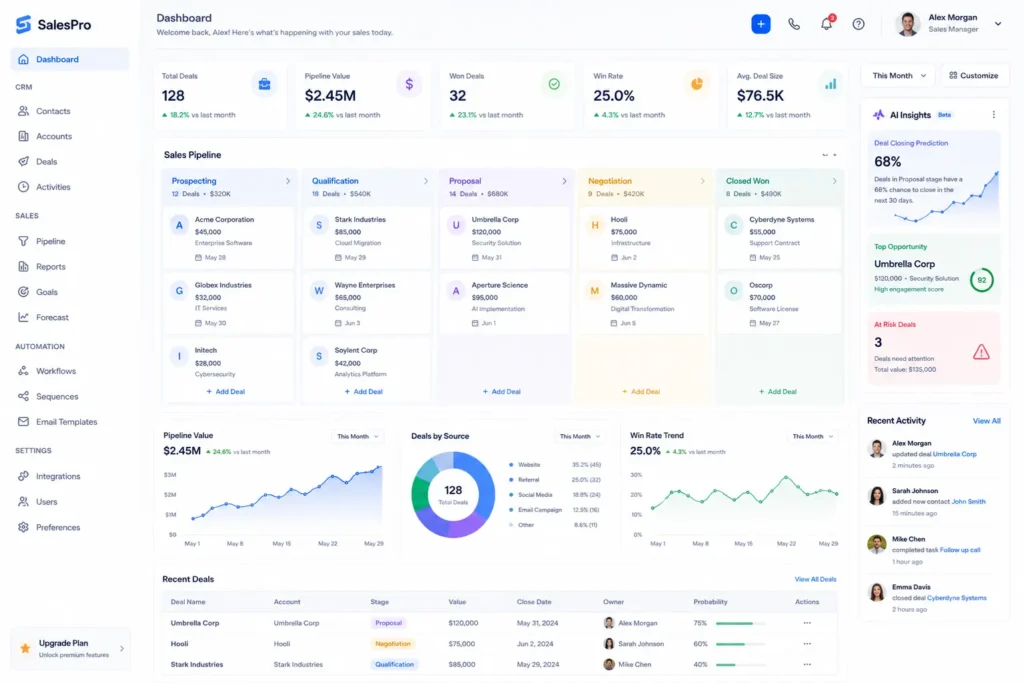
CRM stands for Customer Relationship Management.
A CRM system is designed to help businesses manage every interaction with leads, prospects, and customers.
Think of a CRM as the central hub for your customer relationships.
Instead of keeping information scattered across spreadsheets, notes, emails, and team members’ memories, a CRM stores everything in one place.
This includes:
- Contact information
- Communication history
- Sales opportunities
- Follow-up tasks
- Deal values
- Customer activity
For businesses with sales teams, this visibility is essential.
Without a CRM, leads fall through the cracks, follow-ups get missed, and revenue opportunities disappear.
Core CRM Features
Most CRM platforms include:
Contact Management
Store complete profiles for every lead and customer.
Sales Pipeline Management
Track deals from first contact to closed sale.
Task Automation
Automatically assign follow-ups and reminders.
Team Collaboration
Allow multiple team members to access customer records.
Revenue Forecasting
Predict future sales based on pipeline activity.
How AI Is Transforming CRM Software
CRM platforms have evolved dramatically over the last few years.
Modern systems are no longer simple databases.
AI now helps businesses:
Predict Which Leads Will Convert
Instead of manually evaluating prospects, AI analyzes behavior and predicts purchase intent.
Score Leads Automatically
The system prioritizes prospects most likely to become customers.
Forecast Revenue
AI can estimate future sales based on historical performance and pipeline activity.
Recommend Next Actions
Many CRM platforms now suggest the best follow-up strategy for each lead.
For SaaS companies and agencies, these capabilities can significantly improve sales efficiency.
What Is Email Marketing?
Email marketing software is designed to help businesses communicate with large audiences efficiently.
Rather than managing individual sales relationships, email marketing platforms focus on delivering relevant messages to subscribers and customers.
At its core, email marketing helps businesses:
- Generate revenue
- Build customer relationships
- Increase retention
- Recover abandoned sales
- Nurture leads automatically
Unlike CRM systems, email marketing tools are built around communication and automation.
This is why they remain one of the highest-ROI marketing channels available today.
Core Email Marketing Features
Campaign Creation
Design newsletters and promotional emails.
Audience Segmentation
Group subscribers based on interests and behavior.
Marketing Automation
Send emails automatically based on triggers and actions.
A/B Testing
Optimize subject lines and content.
Performance Analytics
Track opens, clicks, conversions, and revenue.
Deliverability Monitoring
Ensure emails reach inboxes rather than spam folders.
How AI Is Changing Email Marketing
Artificial intelligence is arguably having a bigger impact on email marketing than almost any other digital marketing channel.
Modern platforms now provide:
AI Subject Line Generation
Generate higher-performing subject lines in seconds.
If you’re interested in improving open rates, see our guide on Best Subject Lines for Email Marketing.
AI Email Writing
Draft entire campaigns automatically.
AI Personalization
Customize content for individual subscribers.
AI Product Recommendations
Recommend products based on customer behavior.
AI Send-Time Optimization
Deliver emails when each subscriber is most likely to engage.
AI Newsletter Creation
Many businesses now use AI tools to generate newsletters in minutes.
Related reading: AI Newsletter Generator
CRM vs Email Marketing: 7 Critical Differences
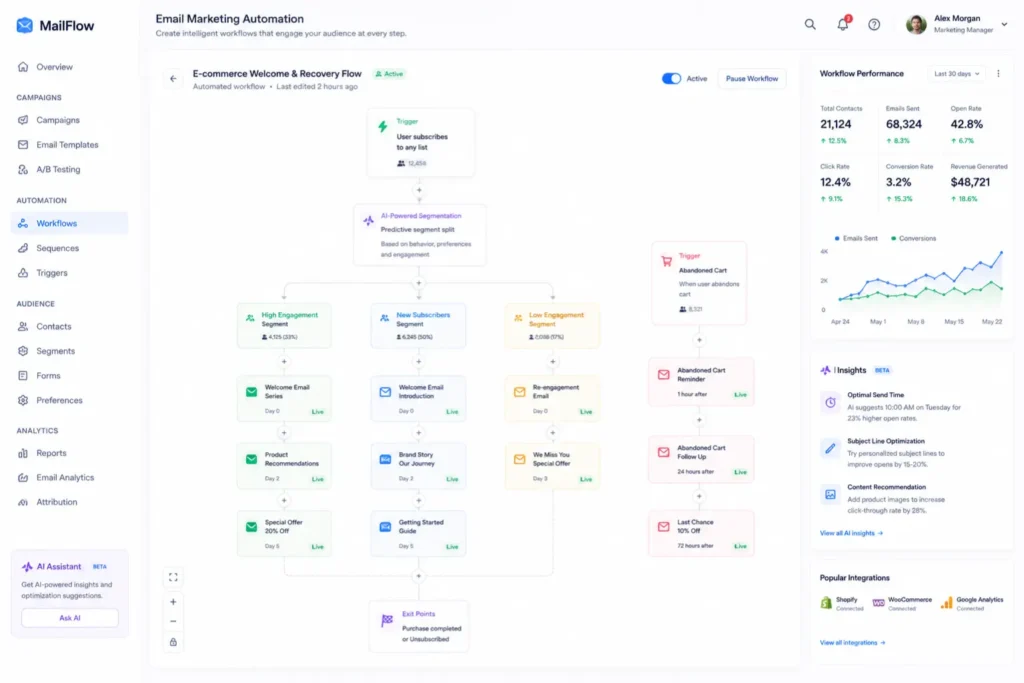
Although modern platforms increasingly overlap, several major differences remain.
1. Purpose
CRM software exists to manage relationships.
Email marketing software exists to communicate at scale.
A CRM helps sales teams move leads through pipelines.
Email marketing helps marketers engage audiences automatically.
This is the most important distinction.
2. Customer Data Management
One of the biggest differences between CRM and email marketing software is how they handle customer data.
A CRM is built to maintain detailed records for every lead and customer. Sales teams can see previous conversations, meetings, support requests, deal stages, and purchase history in a single profile.
Email marketing platforms also store customer information, but their primary focus is subscriber behavior.
For example, an email marketing platform may track:
- Email opens
- Link clicks
- Website visits
- Product purchases
- Subscriber engagement
This data is incredibly valuable for marketing automation, but it usually doesn’t provide the same level of relationship management as a dedicated CRM.
Winner
- CRM for relationship management
- Email marketing for audience behavior tracking
3. Sales Pipeline Management
This is where CRM software clearly wins.
A CRM allows businesses to move prospects through a structured sales process.
Typical pipeline stages include:
- New Lead
- Qualified Lead
- Discovery Call
- Proposal Sent
- Negotiation
- Closed Won
- Closed Lost
Sales teams rely on these stages to manage revenue opportunities efficiently.
Email marketing platforms generally do not include advanced pipeline management features.
If your business closes deals through conversations, demos, or consultations, a CRM is usually essential.
Winner
CRM
4. Automation Capabilities
Both CRM and email marketing platforms offer automation, but they focus on different outcomes.
CRM Automation
CRM systems automate:
- Follow-up reminders
- Task assignments
- Lead routing
- Deal updates
- Sales notifications
Email Marketing Automation
Email marketing platforms automate:
- Welcome sequences
- Abandoned cart emails
- Post-purchase campaigns
- Re-engagement flows
- Lead nurturing campaigns
For most online businesses, email marketing automation generates a more direct impact on revenue.
That’s one reason why email remains one of the most profitable digital marketing channels.
If you’re learning how to improve campaign performance, check out our guide on Best Email Marketing Practices.
Winner
Depends on your business model.
5. Revenue Tracking
Both systems help track revenue, but they do so differently.
CRM Revenue Tracking
CRM software focuses on:
- Deal values
- Pipeline forecasts
- Sales performance
- Customer lifetime value
Email Marketing Revenue Tracking
Email marketing platforms focus on:
- Revenue per campaign
- Revenue per subscriber
- Revenue per automation flow
- Attribution reporting
For ecommerce stores, this level of campaign attribution is extremely valuable.
You can see exactly how much revenue each email generates.
Winner
- CRM for sales forecasting
- Email marketing for campaign attribution
6. AI Capabilities
Artificial intelligence is rapidly transforming both categories.
AI in CRM
Modern CRM platforms use AI for:
- Predictive lead scoring
- Revenue forecasting
- Opportunity analysis
- Sales recommendations
- Conversation intelligence
AI in Email Marketing
Email marketing platforms use AI for:
- Subject line generation
- Email writing
- Product recommendations
- Behavioral segmentation
- Send-time optimization
In many cases, AI is having a greater impact on email marketing because personalization can directly influence engagement and revenue.
Winner
Email marketing currently benefits more from AI-driven automation.
7. Business Use Cases
The final difference comes down to how businesses operate.
CRM Works Best For
- B2B companies
- SaaS sales teams
- Agencies
- Consultants
- Enterprise organizations
Email Marketing Works Best For
- Ecommerce stores
- Affiliate marketers
- Bloggers
- Content creators
- Online businesses
Winner
Depends entirely on your business model.
CRM vs Email Marketing for Different Business Types
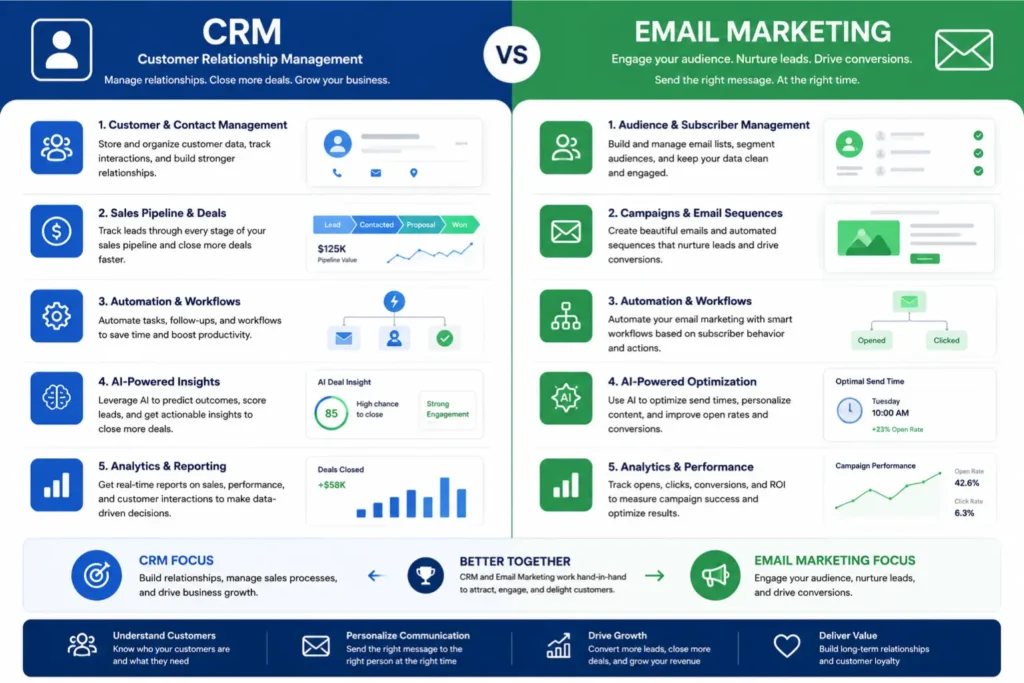
Not every business needs the same tools.
Here’s how to decide based on your business model.
Ecommerce Businesses
For ecommerce brands, email marketing should usually be the first priority.
Why?
Because email directly influences:
- Repeat purchases
- Customer retention
- Cart recovery
- Product recommendations
Platforms like Klaviyo are specifically designed for ecommerce businesses and offer advanced segmentation, predictive analytics, and revenue attribution.
Related Reading:
Shopify Email Marketing vs Klaviyo
Recommended Solution
Email Marketing First
Best Tool:
Klaviyo
Affiliate Marketers
Affiliate marketers rarely need a traditional CRM.
Most affiliate businesses don’t have sales pipelines or account managers.
Instead, success depends on:
- Growing an email list
- Building trust
- Sending targeted promotions
- Automating follow-ups
For this reason, email marketing software is usually a far better investment than CRM software.
Related Reading:
Email Marketing for Affiliate Marketers
Recommended Solution
Email Marketing
Best Tools:
- ConvertKit
- MailerLite
- ActiveCampaign
Content Creators and Bloggers
Creators need audience-building tools more than sales management tools.
Email marketing helps creators:
- Build newsletters
- Promote content
- Launch products
- Engage subscribers
Most creators don’t need advanced CRM functionality until they begin managing sponsorships or sales teams.
Related Reading:
ConvertKit Review
Recommended Solution
Email Marketing
Best Tool:
ConvertKit
SaaS Companies
SaaS businesses often benefit from combining CRM and email marketing.
A CRM manages:
- Leads
- Sales opportunities
- Customer success activities
Email marketing manages:
- Onboarding
- Product education
- Retention campaigns
- Upsell opportunities
This combination creates a complete customer lifecycle system.
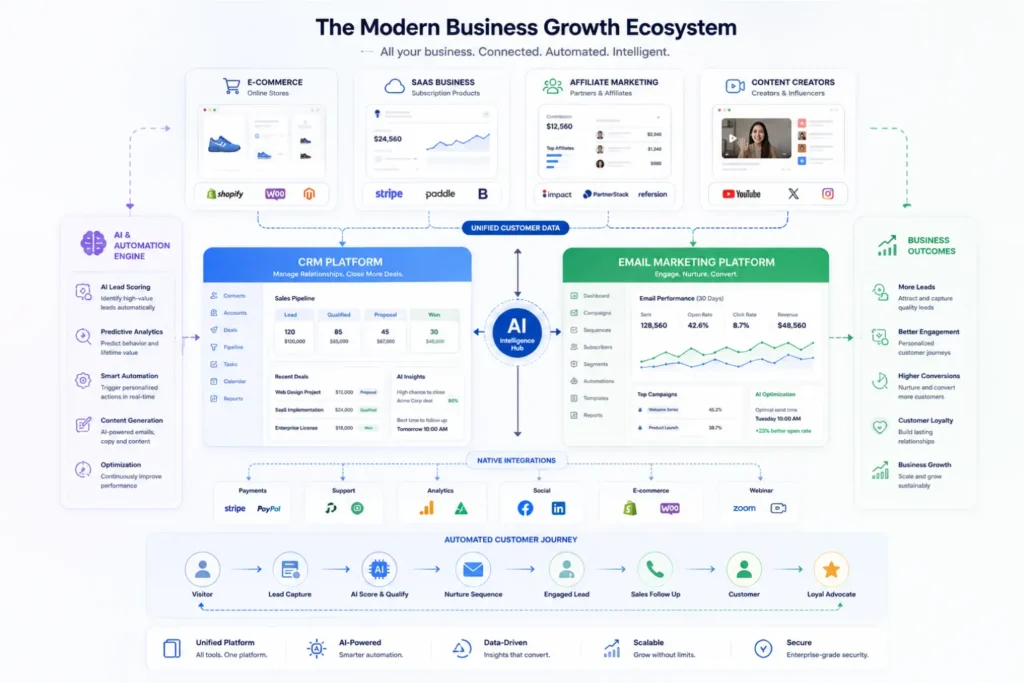
Recommended Solution
CRM + Email Marketing
Best Tool:
ActiveCampaign
Agencies
Agencies typically require both systems.
CRM software helps manage prospects and clients.
Email marketing helps nurture leads and maintain client communication.
As agencies grow, having both systems becomes increasingly important.
Recommended Solution
CRM + Email Marketing
Do You Need CRM, Email Marketing, or Both?
Use this simple decision framework.
Choose CRM If:
- You have a sales team
- You manage deals manually
- Your sales process takes weeks or months
- You need pipeline visibility
Choose Email Marketing If:
- You run an ecommerce store
- You publish content
- You build audiences
- You earn affiliate commissions
Choose Both If:
- You operate a SaaS company
- You run an agency
- You need complete customer lifecycle management
If you want a complete breakdown of the best AI email marketing tools, check our full comparison of the best AI email marketing tools in 2026.
ActiveCampaign
Best all-in-one CRM and email marketing platform.
Strengths:
- Advanced automation
- Built-in CRM
- Lead scoring
- Behavioral tracking
Best For:
SaaS, agencies, service businesses
Best ecommerce email marketing platform.
Strengths:
- Customer segmentation
- Revenue attribution
- Product recommendations
- Shopify integrations
Best For:
Ecommerce stores
Related Reading:
Klaviyo Email Marketing
Best platform for creators.
Strengths:
- Newsletter growth
- Creator-focused automation
- Easy setup
Best For:
Bloggers and creators
Best beginner-friendly option.
Strengths:
- Affordable pricing
- Simple automation
- Easy learning curve
Best For:
Beginners and small businesses
Related Reading:
MailerLite vs GetResponse
Pricing Comparison: CRM vs Email Marketing Tools
Pricing is often one of the biggest factors when choosing between CRM and email marketing software.
The good news is that many modern platforms offer free plans, allowing businesses to get started without a large upfront investment.
| Platform | Starting Price | Best For |
| MailerLite | Free Plan Available | Beginners |
| ConvertKit | Free Plan Available | Creators |
| Klaviyo | Free Plan Available | Ecommerce |
| ActiveCampaign | Paid Plans | Automation & CRM |
| HubSpot CRM | Free Plan Available | Sales Teams |
What Most Businesses Should Do
If you’re just starting out, invest in email marketing first.
A strong email list often generates revenue long before a CRM becomes necessary.
As your business grows and your sales process becomes more complex, you can add CRM functionality later.
For most affiliate marketers, bloggers, and ecommerce businesses, email marketing delivers a faster return on investment.
Common Mistakes Businesses Make
Many businesses waste money because they choose the wrong tool at the wrong stage.
Mistake #1: Buying a CRM Too Early
A CRM is powerful, but only if you have enough leads and sales activity to justify it.
Many small businesses purchase expensive CRM software before they even have a predictable lead generation system.
Mistake #2: Ignoring Email Automation
Email automation can generate sales around the clock.
Businesses that rely entirely on manual communication often miss opportunities to nurture leads and retain customers.
Mistake #3: Treating Email Marketing as a Newsletter Tool
Modern email marketing is far more than sending newsletters.
Today’s platforms can automate customer journeys, personalize recommendations, and generate significant revenue through behavioral targeting.
Mistake #4: Using Too Many Tools
A disconnected technology stack creates unnecessary complexity.
Whenever possible, choose tools that integrate well together or offer both CRM and email marketing capabilities.
Affiliate Recommendation: Which Tool Should You Choose?
If you’re still unsure which platform fits your business, use this quick guide.
Choose Klaviyo If:
- You run an ecommerce store
- You use Shopify
- You want advanced segmentation
- You need abandoned cart automation
Klaviyo is one of the strongest ecommerce marketing platforms available today because it combines customer data, automation, and revenue tracking in a single system.
Related Reading:
Shopify Email Marketing vs Klaviyo
Choose ConvertKit If:
- You’re a blogger
- You’re building a newsletter
- You’re a content creator
- You want simplicity
ConvertKit focuses on helping creators grow audiences and monetize subscribers.
Related Reading:
ConvertKit Review
Choose MailerLite If:
- You’re on a budget
- You’re just getting started
- You want an easy learning curve
MailerLite offers an excellent balance of simplicity and affordability.
Related Reading:
MailerLite vs GetResponse
Choose ActiveCampaign If:
- You need CRM + Email Marketing
- You run a SaaS company
- You operate an agency
- You want advanced automation
ActiveCampaign is one of the few platforms that successfully combines CRM functionality with powerful marketing automation.
CRM vs Email Marketing: Frequently Asked Questions
Is CRM the same as email marketing?
No.
CRM software manages customer relationships, sales pipelines, and lead tracking.
Email marketing software focuses on campaigns, automation, audience engagement, and customer retention.
Although some platforms combine both capabilities, they remain distinct categories.
Can email marketing replace a CRM?
In some cases, yes.
If you’re an affiliate marketer, creator, blogger, or ecommerce business without a sales team, email marketing software may be sufficient.
However, businesses that manage deals, sales pipelines, or complex customer relationships usually need a CRM.
Can a CRM send marketing emails?
Many CRM platforms include email marketing functionality.
However, dedicated email marketing platforms typically provide stronger automation, segmentation, personalization, and deliverability features.
Do affiliate marketers need a CRM?
Usually not.
Most affiliate marketers generate revenue through audience building and email automation rather than sales pipelines.
For that reason, investing in a quality email marketing platform is often the smarter choice.
Related Reading:
Email Marketing for Affiliate Marketers
What is the best CRM and email marketing platform?
The answer depends on your business model.
- Ecommerce: Klaviyo
- Creators: ConvertKit
- Beginners: MailerLite
- SaaS and Agencies: ActiveCampaign
Is AI replacing CRM and email marketing?
No.
AI is enhancing both categories rather than replacing them.
CRM systems use AI for lead scoring, forecasting, and sales recommendations.
Email marketing platforms use AI for personalization, content generation, segmentation, and optimization.
Businesses that effectively combine AI with CRM and email marketing often gain a significant competitive advantage.
Final Verdict: CRM vs Email Marketing
The CRM vs Email Marketing debate isn’t really about choosing one over the other.
It’s about choosing the right system for your current stage of growth.
If your business depends on managing leads, tracking deals, and coordinating sales activities, a CRM is essential.
If your business depends on audience building, customer retention, ecommerce sales, or affiliate marketing, email marketing should usually be your first investment.
For many modern businesses, the best long-term solution is a combination of both.
The Bottom Line
Choose CRM if:
- You manage sales opportunities
- You have a sales team
- You need pipeline visibility
Choose Email Marketing if:
- You run an ecommerce store
- You build audiences
- You create content
- You earn affiliate commissions
Choose Both if:
- You run a SaaS business
- You operate an agency
- You want complete customer lifecycle management
The most successful businesses in 2026 aren’t asking:
“CRM or Email Marketing?”
They’re asking:
“How can we use CRM, Email Marketing, and AI together to create a better customer experience and drive more revenue?”
Related Articles