
If you’ve ever hit “send” on a campaign and then just… waited, wondering why opens trickled in slower than a Monday morning coffee line, you already know that timing isn’t a footnote in email marketing. It’s a lever. Finding the best time to send email marketing in 2026 has become even more important, with inboxes more crowded and attention spans thinner than ever – pulling that lever correctly is the difference between a campaign that gets read and one that gets buried under fifty other subject lines.
So let’s answer the question everyone’s actually asking: what is the best time to send email marketing in 2026? Below is a practical, data-informed breakdown you can start applying today.
Table of Contents
I. The Best Time to Send Email Marketing in 2026: A Quick Cheat Sheet
Let’s cut to the chase before we get into the why – here’s the best time to send email marketing at a glance.
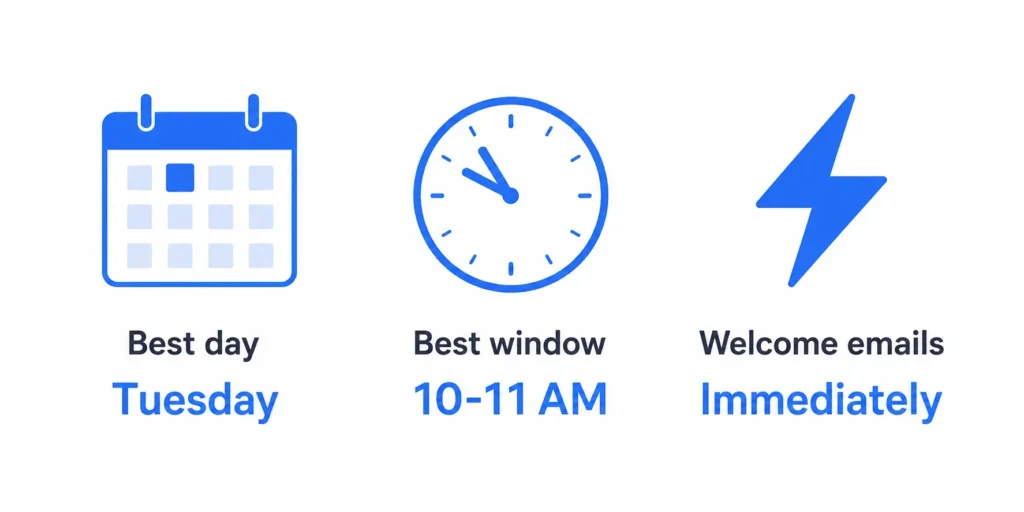
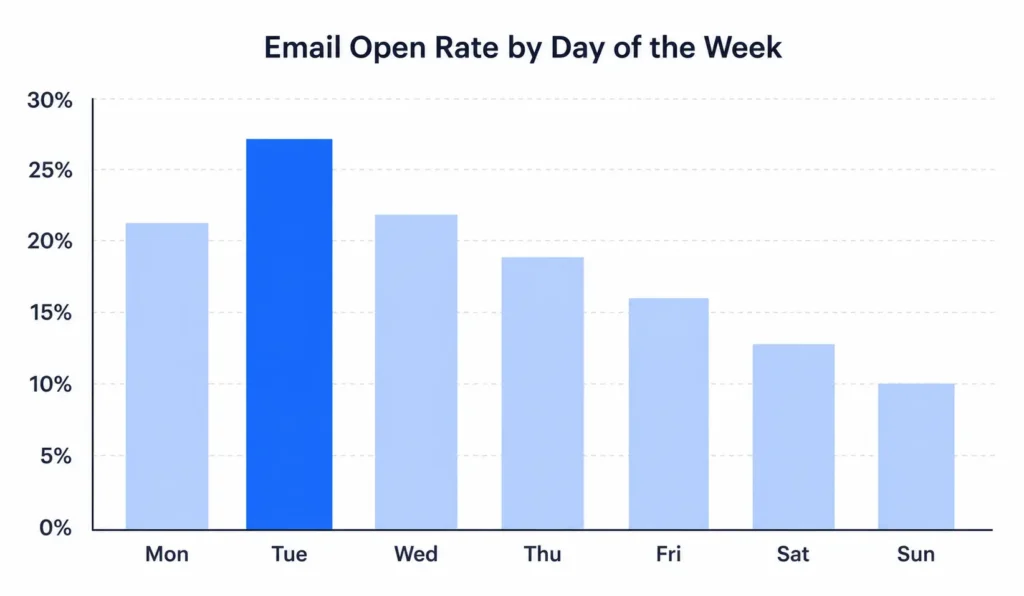
The midweek winner is still Tuesday. Year after year, Tuesday holds its ground as the strongest day for engagement, and 11 AM EST continues to be a sweet spot – right when people have cleared their initial inbox triage but haven’t yet slipped into afternoon fatigue.
The optimal morning window sits between 10 AM and 11 AM. It’s a deliberate gap: late enough to dodge the frantic Monday-style morning rush of emails, meetings, and Slack pings, but early enough to beat the midweek slump where attention starts fraying by early afternoon.
The exception to all of this is the welcome email. Forget scheduling windows entirely – the best time to send a welcome email is immediately. Intent is highest the second someone signs up, and every hour of delay chips away at that momentum.
II. Benchmarks and Data: Why Email Marketing Timing Actually Matters
Here’s the thing people underestimate: the best time to send email marketing doesn’t just affect whether your message gets delivered. It affects whether it gets seen. A well-timed send lands near the top of an inbox when a recipient is actually looking, rather than getting swallowed by twenty newer messages an hour later.
Holiday sending is its own animal. During Black Friday and Cyber Monday, historical data shows peak sending volume clusters around 7 AM, while peak opens tend to land between 8 AM and 9 AM MDT – that gap tells you something important: people are checking phones before they’re checking email. Memorial Day follows a similar sending pattern, with peak dispatch still around 7 AM, though open behavior gets noticeably less predictable across a long weekend.
And then there’s the broader trend worth remembering: engagement tends to erode as the week wears on. Open rates that look strong on Tuesday often sag by Friday and drop further into the weekend, particularly for B2B audiences. This lines up with independent data from two major platforms – Mailchimp’s email marketing benchmarks and Brevo’s 2026 marketing benchmark report – both of which show Tuesday and Wednesday consistently outperforming the rest of the week across most industries.
III. Tailoring the Best Send Time by Email Marketing Campaign Type
Not every email deserves the same slot on the calendar – the best time to send email marketing shifts depending on what you’re actually sending.
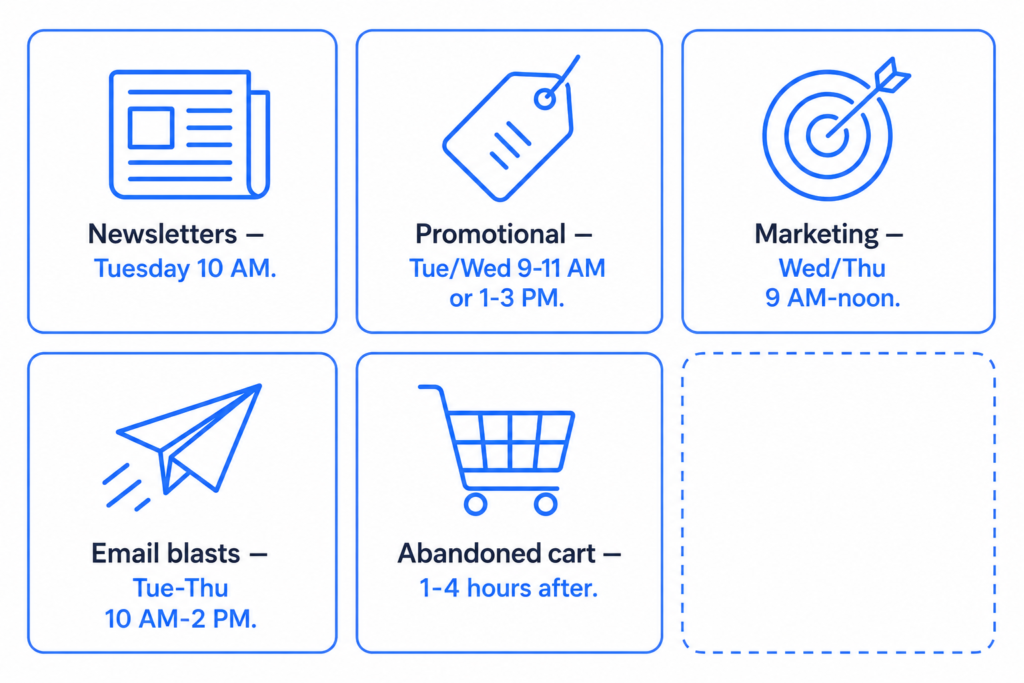
- Newsletters: Tuesday at 10 AM remains the gold standard – consistent, expected, and timed for that “catching up on industry news” mindset.
- Promotional emails: Aim for natural work-break windows – 9-11 AM or 1-3 PM – ideally on a Tuesday or Wednesday, when people are more likely to browse rather than just skim.
- Marketing emails: Wednesday or Thursday mornings, roughly 9 AM to noon, tend to catch people during planning-mode thinking, which works well for anything requiring a decision.
- Email blasts: Steer clear of Monday and Friday altogether. The Tuesday–Thursday stretch between 10 AM and 2 PM is far more forgiving.
- Abandoned cart reminders: Speed matters here more than day-of-week strategy. Send within one to four hours of the abandonment while purchase intent is still fresh – Klaviyo’s 2026 benchmark data shows automated flows like these generate dramatically higher revenue per recipient than standard campaigns, largely because they catch people at the moment of highest intent.
If you’re building a list around promotions and commissions rather than just a newsletter, timing interacts with strategy in a bigger way than most people expect – our guide to email marketing for affiliate marketers breaks down the send cadences and automation flows that tend to perform best for that specific model.
IV. Technical Pro Tips Most Marketers Miss
This is where the details separate amateur sends from a truly optimized email marketing send time.
The odd-minute rule is one of the more overlooked tactics: avoid sending exactly on the hour or at the 15, 30, or 45-minute marks. Everyone else is sending then, which creates ISP traffic congestion. Instead, schedule sends at oddball minutes – 7, 21, or 36 minutes past the hour -to slip past the bottleneck and often land faster in the inbox.
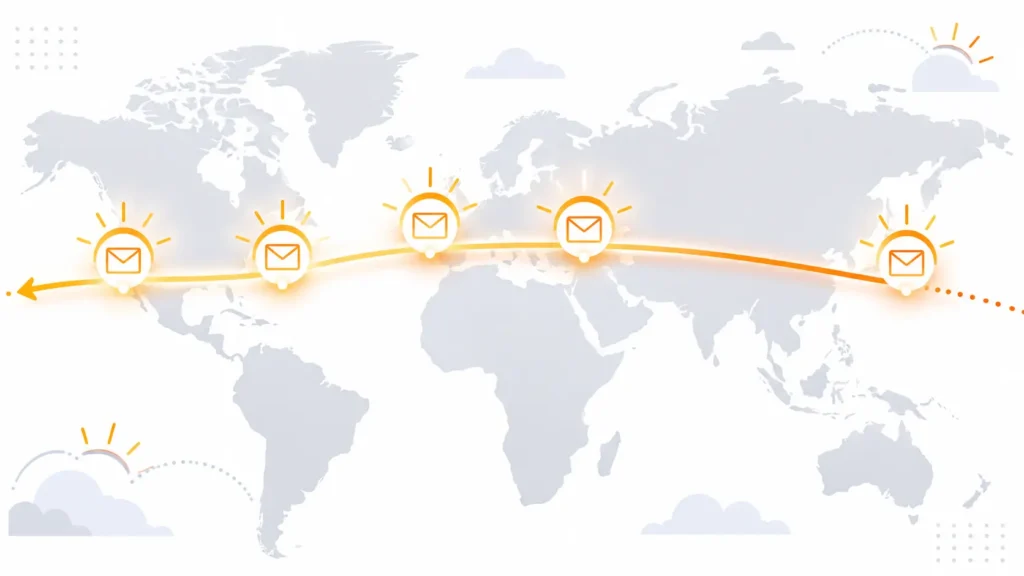
The “follow the sun” strategy works especially well for global lists. Rather than blasting your entire audience at once, split the campaign into smaller batches – around 38 segments works well for many list sizes – timed so each group receives the email as morning rises in their specific time zone.
V. Testing to Find Your Own Best Time to Send Email Marketing
Benchmarks are a starting line, not a finish line. The best time to send email marketing for your list specifically depends on your audience’s own rhythm, and finding it requires structured testing.
Run A/B tests comparing weekday versus weekend sends, and separately test time blocks like start-of-day versus lunch hour. Don’t stop at open rates – they’re a shallow metric. Look at click-through rate, conversion rate, and revenue per email to understand what timing actually drives business results.
For statistical confidence, aim for at least 1,000 recipients per variant, and run the test across three to four separate campaigns before locking in a permanent schedule change.
VI. Expert FAQ: Best Time to Send Email Marketing and Common Pitfalls
What about holidays? B2B senders generally do best avoiding holiday windows entirely – decision-makers simply aren’t checking work email. B2C retail brands, on the other hand, often see strong performance the day before or after a holiday, when shopping intent spikes.
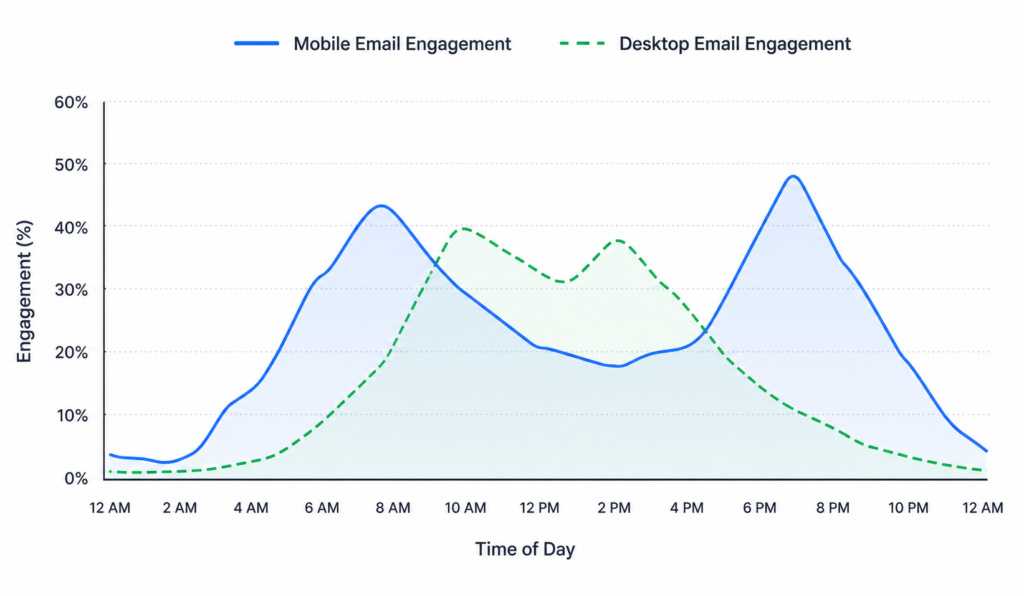
Mobile vs. desktop behavior? Mobile opens surge during early morning hours (6–8 AM) and evening commutes (5–7 PM), while desktop engagement clusters around traditional business hours – mid-morning and just after lunch. This tracks with Litmus’s email client market share data, which consistently shows mobile devices accounting for the majority of email opens industry-wide.
Do B2B and B2C audiences behave differently on weekends? Significantly. B2B buyers rarely engage on Saturday or Sunday, while B2C consumers frequently browse and shop on Saturday mornings.
VII. Conclusion: Content Still Wins
Here’s the honest truth beneath all this data: even the best time to send email marketing only amplifies good content – it doesn’t replace it. Send a mediocre email at the “perfect” moment and it will still underperform. Timing gets your message in front of the right eyes; the message itself still has to earn the click. That’s exactly why the subject line still matters as much as the send time – if you need a refresher, our roundup of 28 top email subject lines is a good next stop for the copy side of this equation
Use these 2026 benchmarks as your starting framework for finding the best time to send email marketing to your own list, then test relentlessly against your audience’s actual behavior. And since the results you get will depend heavily on which platform you’re actually sending from, it’s worth comparing your options before you commit – check out our list of the best AI email marketing tools in 2026 for a tested, ranked breakdown of what’s worth using this year.