
Introduction
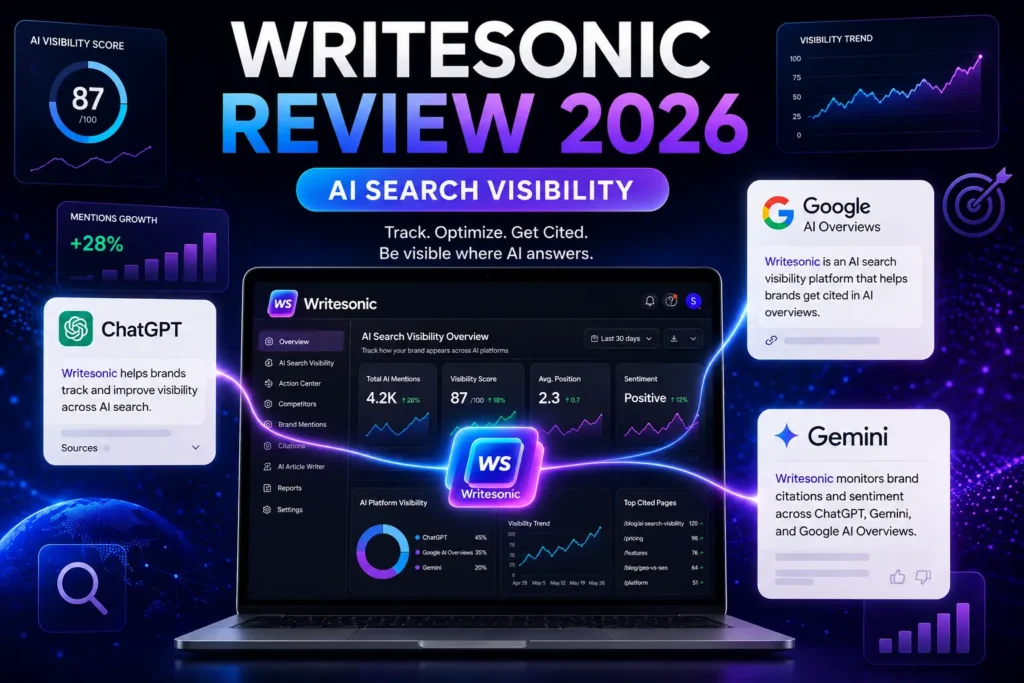
If the last Writesonic review you read described it as an AI writing tool, that review is out of date. Writesonic has changed identity – twice. It launched in 2020 as a GPT-powered content generator, expanded into SEO tooling in 2023, and by 2026 had repositioned entirely around AI Search Visibility, tracking how brands appear in ChatGPT, Gemini, and Google AI Overviews. Its official pricing page today sells that platform first; the AI Article Writer that originally made Writesonic’s name now shows up as a minor feature bullet inside a GEO-tracking subscription.
That matters a lot if you’re an email marketer weighing Writesonic against tools like Jasper or Copy.ai. This review evaluates what’s actually still here for writing email copy, what’s disappeared, and whether the current pricing makes sense if AI search visibility isn’t something you need.
Table of Contents
Quick Answer
This Writesonic review’s short answer: Writesonic is no longer built primarily for email marketers, or for content writers generally. It’s now priced and structured as a GEO (Generative Engine Optimization) platform starting at $79/month, with AI article generation bundled in as a secondary capability rather than the core product. If you specifically need email copywriting, Jasper or Copy.ai will serve that need more directly and at a lower entry price. Writesonic only makes sense here if you also want AI search visibility tracking – the email-writing capability is a genuine bonus on top of that, not a reason to buy on its own.
What Is Writesonic?
How Writesonic Got Here
Writesonic was founded by Samanyou Garg in San Francisco in 2020 (originally under the name Magicflow), backed by Y Combinator with about $2.5–2.7 million in seed funding. It started as a straightforward GPT-based writing assistant for blog posts, ads, and product descriptions. From there, it expanded fast: SEO tooling in 2023, an SEO-focused AI agent in 2024, and by 2026 a full rebuild into an AI Search Visibility platform tracking brand citations across ChatGPT, Gemini, and Google AI Overviews. Y Combinator’s own company page now describes Writesonic as helping “13,000+ teams dominate AI search,” with essentially no mention of email or general content writing.
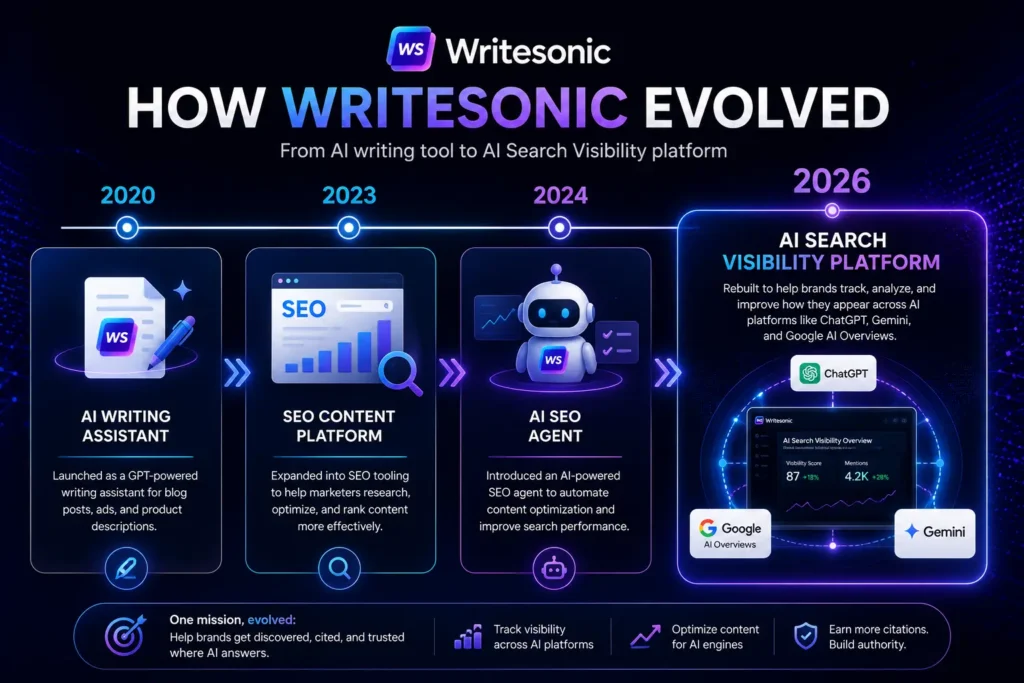
For readers here specifically for email marketing, the key finding of this Writesonic review is simple: the AI Article Writer still exists and still works, but it’s a secondary line item inside a GEO subscription now, not a purpose-built email tool.
How Writesonic Works
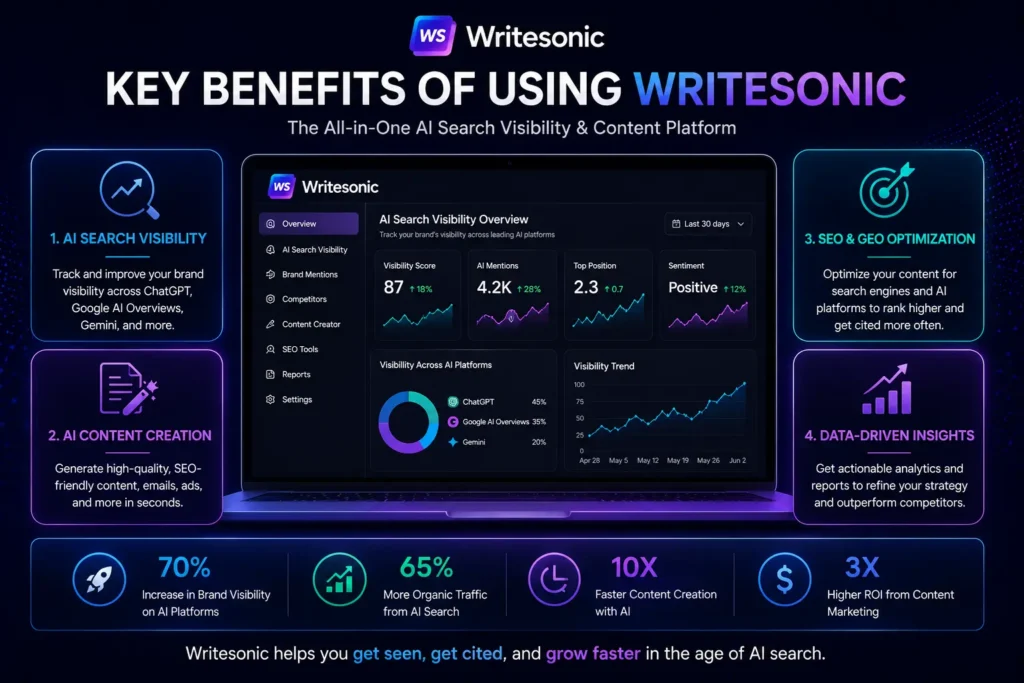
The current platform centers on tracking, not drafting. You connect your brand, and Writesonic monitors how often and how favorably you’re cited across AI platforms, benchmarks that against competitors, and surfaces an “Action Center” of fixes – some of which involve generating or refreshing content. The AI Article Writer sits inside this workflow as a content-creation tool, usable independently for blog posts, ad copy, and – with more manual adaptation – email copy, though nothing in the current interface is purpose-built around email format or send-context the way Jasper’s or Copy.ai’s dedicated email tooling is.
Key Features for Email Marketing
AI Article Writer
What it does: generates long-form and short-form drafts, including email-adaptable copy, using real-time web data to keep facts current. Who benefits: marketers who want one tool for both blog content and occasional email copy. Limitation: it’s built and optimized for articles first – outputs read more like web copy than conversational email copy without editing.
Content Optimization / SEO Checker
What it does: scores drafts against competitor content and suggests keyword and structural improvements. Who benefits: content marketers managing blogs alongside email newsletters. Limitation: not available on the entry Starter tier – it’s locked to Enterprise, so most email-focused buyers won’t have access to it at all.
Brand Voice (“Writing Styles”)
What it does: lets you set a consistent tone profile. Who benefits: teams keeping voice consistent across blog and email content. Limitation: capped at just 1 writing style on the Starter tier ($79/month) — multi-brand or multi-client use requires Basic ($199/month) or higher.
AI Search Visibility Tracking
What it does: monitors and reports how your brand is cited across ChatGPT, Gemini, and Google AI Overviews. Who benefits: teams already investing in AI-search/GEO strategy who’d also like content generation bundled in. Limitation: for an email-only buyer, this is the majority of what you’re paying for and won’t use.
Pricing & Value Analysis
The pricing breakdown at the center of this Writesonic review – confirmed directly from writesonic.com/pricing – is structured entirely around AI search visibility, not content volume:
- Starter — $79/month (billed annually): 1 user, 1 project, 15 AI articles/month, 50 AI prompts tracked daily across ChatGPT/Gemini/Google AI Overviews, 10 site audits.
- Basic — $199/month: 2 users, 25 articles/month, 100 prompts tracked, sentiment analysis unlocks on Growth, not here.
- Growth (most popular) – $399/month: 3 users, 50 articles/month, 200 prompts tracked, sentiment analysis and a limited Action Center included.
- Enterprise — custom pricing: all 10 AI platforms tracked (including Perplexity, Claude, Microsoft Copilot), full Action Center, content optimization, SSO/SAML, dedicated AI search strategist.
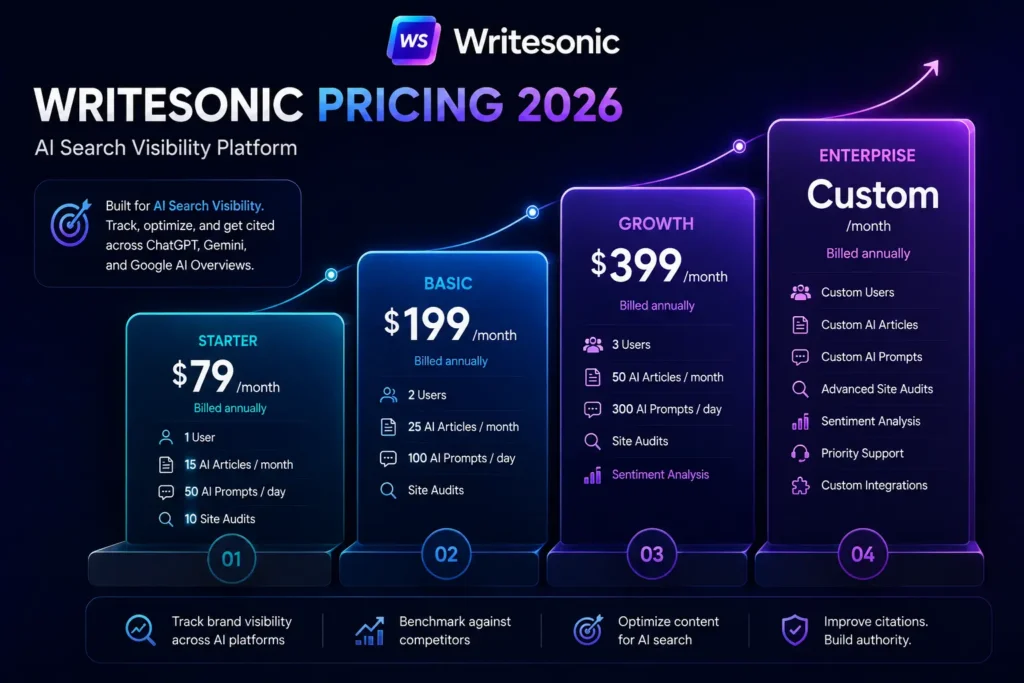
A necessary caution: third-party pricing pages currently cite wildly different numbers for Writesonic – some as low as $10–20/month, others in the $39–79 range. Those reflect Writesonic’s earlier, pure-content-tool pricing structure and are out of date. Treat any Writesonic price outside the $79–$399+ range as stale.
There is a free trial (no credit card required), but no permanent free tier — a change from the older “Free plan with limited words” structure some reviews still describe.
The honest math for email marketers: $79/month for 15 AI articles and email-adaptable drafts is a poor trade if AI search visibility isn’t something you need — Jasper’s Pro plan starts at $69/month with no GEO overhead, and Copy.ai’s Chat plan starts at $29/month for comparable short-form output. Writesonic’s pricing only earns its cost if the GEO tracking is genuinely part of your marketing strategy.
User Experience
Reviewers consistently describe the interface as intuitive for content generation, with a real learning curve on the broader platform — G2 and Capterra reviewers repeatedly note the AI search visibility dashboard, Action Center, and prompt-tracking tools take longer to learn than the writing tools alone. For someone landing in Writesonic purely to write emails, the interface will feel like navigating past a lot of GEO-dashboard surface area to reach a comparatively small writing feature.
AI Capabilities for Email Copy
The underlying article writer draws on multiple models (GPT-4, Claude, and Gemini are all referenced in Writesonic’s own materials) and includes real-time web research, which is genuinely useful for keeping factual claims current — a real edge for newsletters that reference trends, data, or news. What it lacks is anything specific to email structure: no subject-line-specific generation mode, no send-time or deliverability-aware guidance, and no dedicated welcome/nurture/re-engagement templates the way Jasper and Copy.ai both offer. You’re adapting general-purpose long-form output into email format yourself.
Integrations
One integrations gap stood out clearly while researching this Writesonic review: the current list, per Writesonic’s own pricing page, includes Google Search Console and WordPress at every tier, plus GA4 and Looker Studio at Enterprise. Notably absent from the entire published integration list: any email service provider. No Mailchimp, no HubSpot, no Klaviyo, no direct ESP connection at any tier. This is a meaningful gap for a tool an email marketer would be evaluating — output has to be copy-pasted into your ESP manually regardless of plan.
Real Email Marketing Use Cases
Newsletters — A genuine strength, given the real-time research capability; drafts referencing current data or trends need less fact-checking than static-knowledge tools.
Promotional Emails — Workable, though output leans toward web-copy phrasing and needs editing to sound conversational rather than article-like.
Welcome Sequences — No dedicated template or workflow for this; you’re building it manually from general content prompts.
Cold Outreach — Not a strength; nothing in Writesonic’s current feature set is built for personalized, prospect-specific outbound copy the way Copy.ai’s Workflows are.
Re-engagement Campaigns — Same limitation as Welcome Sequences: usable with manual prompting, but not purpose-built.
Pros
- Real-time web research keeps factual content current, which matters for newsletters citing data, trends, or news — this benefits any marketer producing time-sensitive content and is a genuine edge over tools with static training data.
- Multi-model access (GPT-4, Claude, Gemini) benefits teams wanting output variety without separate subscriptions to each model provider.
- Strong third-party ratings — 4.7/5 on G2 (over 2,000 reviews) and 4.8/5 on Capterra — reflect broad satisfaction, though these ratings substantially predate and don’t specifically evaluate the 2026 GEO repositioning.
- AI search visibility tracking is a genuine value-add for teams already investing in GEO strategy who’d also like content generation in the same subscription, avoiding a second tool for drafting.
- Free trial available to test output quality before committing, no credit card required.
Cons
- Pricing is structured for GEO buyers, not email marketers. Starting at $79/month for a platform where content generation is a minor feature is a poor value trade if visibility tracking isn’t something you need; the workaround is to price it against what you’d actually use, not the full feature list.
- No email service provider integrations at any tier. Content must be manually copied into your ESP; there’s no workaround beyond accepting the extra step.
- No email-specific templates or workflows. Marketers writing welcome sequences, nurture flows, or cold outreach get general-purpose long-form tooling adapted to email, not tooling built for it — pairing Writesonic drafts with a dedicated email tool covers the gap.
- Content Optimization is locked to Enterprise. Teams on Starter, Basic, or Growth don’t get Writesonic’s own competitive content scoring — only custom-priced Enterprise buyers do.
- Third-party pricing information is widely inconsistent and outdated. Multiple current review sites still cite $10–49/month figures; always verify directly on writesonic.com/pricing before budgeting.
Comparison with Key Competitors: Writesonic vs. Jasper vs. Copy.ai
This part of the Writesonic review is the one most readers came for. The clearest way to think about these three tools now is by what each one actually is in 2026, not what each used to be. Jasper has stayed a content-and-brand-voice platform, with pricing built around content production ($69/month Pro). Copy.ai pivoted toward GTM and sales automation, but kept an affordable $29/month entry tier for straightforward short-form writing. Writesonic pivoted furthest of the three — into AI search visibility — and its pricing reflects that: the cheapest plan is $79/month, and content generation rides along as a secondary feature rather than the reason to subscribe.
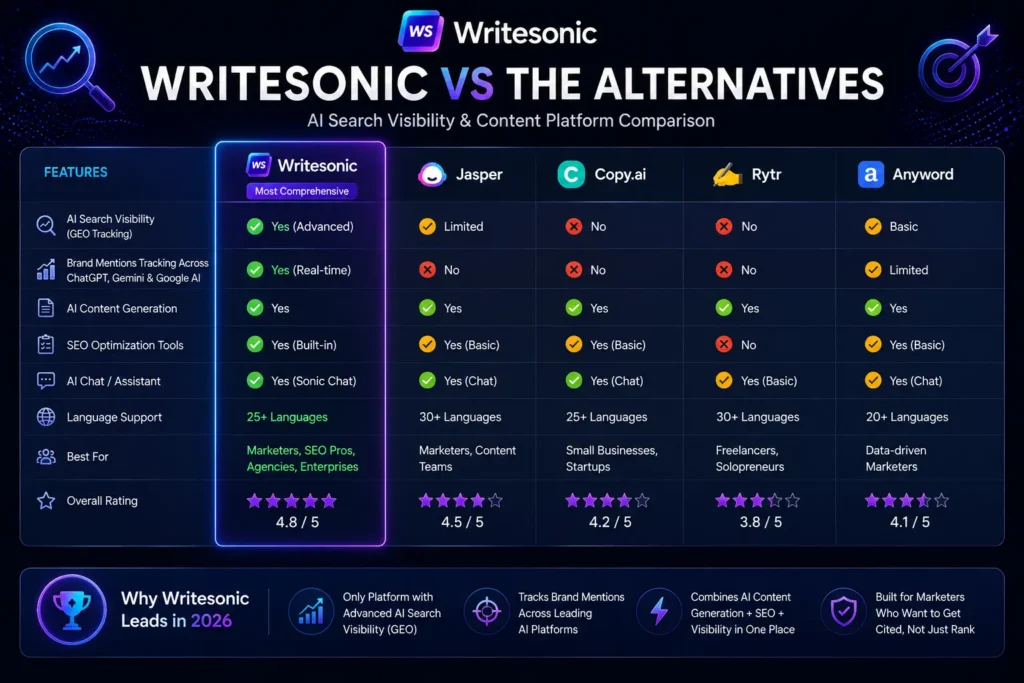
For email marketing specifically: if you want a tool built around writing, Jasper or Copy.ai will serve you better and cheaper. Writesonic only becomes the right call if AI search visibility tracking is genuinely part of your broader marketing stack, and email copy is a bonus you’d use because it’s already included.
Best For / Not Ideal For
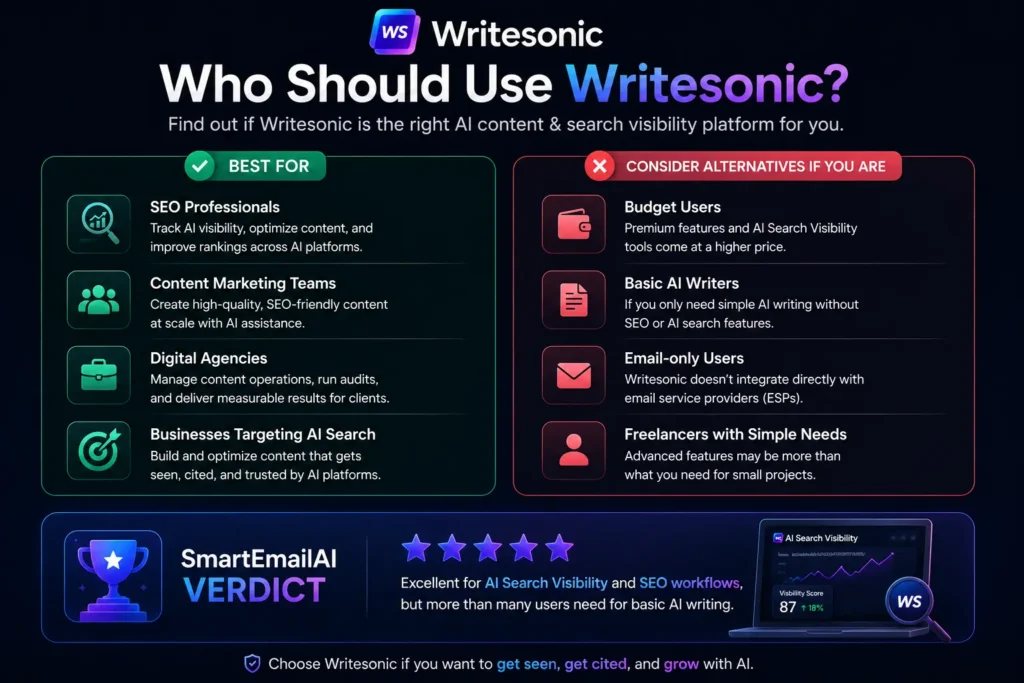
Based on everything covered in this Writesonic review, here’s who it actually fits:
Best For:
- Marketing teams already prioritizing AI search visibility (GEO/AEO) who want content generation bundled into that same subscription, avoiding a separate writing tool.
- Agencies managing brand visibility tracking for multiple clients, where the AI Article Writer is a genuine bonus on top of the core service.
- Teams that specifically value real-time web research in drafts — newsletters and content referencing current data or trends.
Not Ideal For:
- Email marketers whose primary need is writing — the entry price doesn’t make sense against what you’d actually use.
- Anyone needing direct ESP integration — there isn’t one at any tier.
- Solo marketers or freelancers on a budget — at $79/month minimum, this is priced well above Jasper’s and Copy.ai’s entry tiers for anyone not also using the GEO features.
Writesonic Alternatives
If this Writesonic review has made one thing clear, it’s that email copy is no longer the platform’s focus. If email copy is your primary need, Jasper offers more predictable content-focused pricing with stronger brand-voice tooling. Copy.ai is the cheaper entry point for short-form email drafting at $29/month. If AI search visibility genuinely is a priority alongside content, Writesonic remains a reasonable choice — just budget for what it actually is now, not what older reviews describe.
Final Verdict
The verdict of this Writesonic review comes down to fit, not quality: Writesonic in 2026 is a capable AI search visibility platform that happens to still write decent content — not a content tool that happens to track visibility. For an email marketer evaluating it purely on writing needs, the math rarely works: you’d be paying GEO-platform prices for a feature that’s a small part of the product, with no ESP integration and no email-specific tooling to show for it. If your team already needs AI search visibility tracking, the bundled writing capability is a legitimate bonus. If you don’t, Jasper or Copy.ai will serve your email copywriting needs more directly, and for less money.
FAQ
What does this Writesonic review conclude overall? Writesonic is a strong AI search visibility platform first and an email-writing tool second — worth it if you need GEO tracking, not worth it if email copy is your only requirement.
Is Writesonic still an AI writing tool? It still includes an AI Article Writer, but its current pricing and product identity center on AI search visibility (GEO) tracking, not content writing.
How much does Writesonic cost in 2026? Plans start at $79/month (Starter, billed annually), rising to $199 (Basic) and $399 (Growth), with custom Enterprise pricing above that. Older figures citing $10–49/month reflect an outdated pricing structure.
Does Writesonic integrate with email service providers? No. As of its current pricing and integrations page, Writesonic connects to Google Search Console, WordPress, GA4, and Looker Studio, but no email service provider.
Is Writesonic good for writing email newsletters? It can produce usable newsletter drafts, particularly where current data or trends matter, thanks to its real-time web research. It has no dedicated newsletter template or email-specific formatting tools, however.
Who founded Writesonic? Samanyou Garg founded Writesonic (originally as Magicflow) in San Francisco in 2020, backed by Y Combinator.
Is Writesonic worth it if I only need email copy? Generally, no. Jasper and Copy.ai are both built around content and email writing specifically and cost less at the entry tier than Writesonic’s cheapest plan.
What happened to Writesonic’s free plan? Writesonic now offers a free trial rather than a permanent free tier, a change from its earlier content-tool pricing structure.
How does Writesonic compare to Jasper for email marketing? Jasper is the more direct fit — it’s priced and built around content production, including email, without GEO-platform overhead. Writesonic’s email capability is a secondary feature of a different core product.